

i'm done pretending fun isn't enough
some sunday thoughts about love and fun and all that good stuff

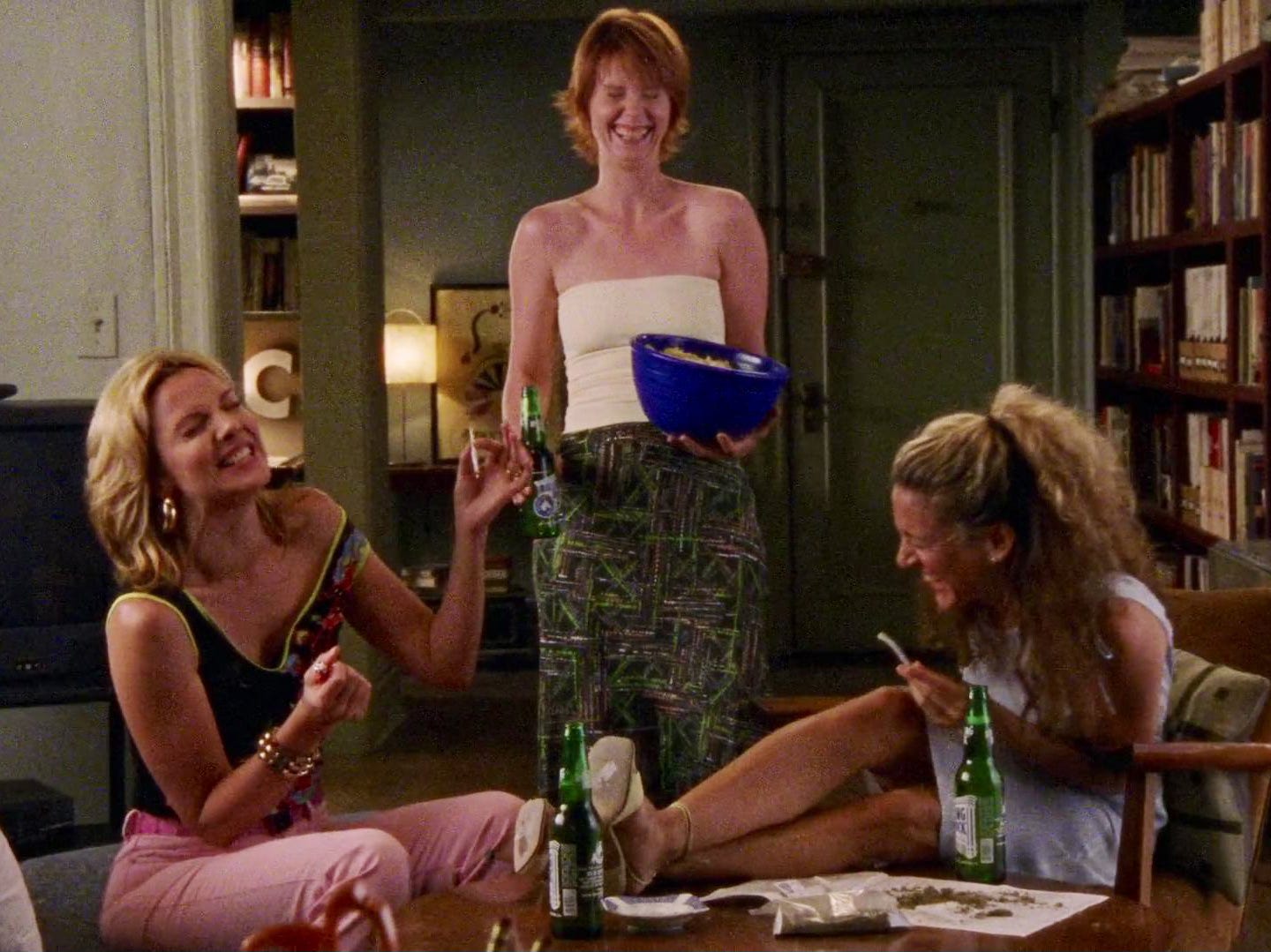
A book I go back to often is “Happy Hour” by Marlowe Granados. It was a book I picked up when I was reading a lot of “doomed” literary fiction. You know, the books about women who have bad sex with bad men and come away from everything feeling a sense of guilt because they are always trying to mold themselves into a shape not designed for them. “Happy Hour” was like sipping a cold drink by the beach, it didn’t take itself too seriously, it was eclectic and refreshing, told from the point of view of a young girl trying to have a life in New York City. It reads how having a fun night out feels, like if Sex And The City’s “Hot Child in the City” episode was a book.
I remember reading it when I was still in Karachi, on the bus home (back when the government loved me enough to give me semi-safe public transportation). My friend was texting me about her latest situationship (one day that word will become extinct). They were not really dating, not really not-dating, it was just this Ambient Presence of someone who texts at odd hours and makes plans that fall through. Someone who always likes your Instagram story and then goes and gets married to another girl six months later. “Why do we do this?” she texted. What a question! I’m not sure we can devise abject truths about ourselves any more than we can comprehend the rest of our lives with certainty. But I kept thinking about Isa, Granados’ protagonist, and her refusal to apologize for wanting things: a good meal, a beautiful dress, the attention of interesting people, without mortgaging those wants against some future promise of seriousness.
I’ve been thinking about “fun” a lot, and how the more fun I have in life, the less grounded I feel. It seems to be some kind of magic syrup that takes you away from the present, that blurs the veil between dimensions or at least becomes the doorway for a New World, where you can wear a mask and dance with a stranger and leave the party feeling like life is full of life-magic. But there’s a guilt that comes with it, isn’t there? A voice that asks: When are you going to be serious? When are you going to want something real?
*
Last month, I went to a dinner party where everyone seemed to be coupled up except for me and a few other friends. At some point, the conversation turned to weddings, as they do (you can take the Pakistani out of Pakistan, or whatever they say). One of the married women looked at us, the unmarried contingent, with something between pity and curiosity. “So when’s your turn, girls? You don’t want someone to come home to?”
I wanted to say: I come home to myself. I come home to my friends. I don’t have a cat yet, but when I do, I’ll come home to it (no girl-cat, boy-cat nonsense on my blog please!) Instead, I smiled, grabbed my friend’s hand and said “We’re marrying each other!”
Why is “coming home to someone” framed as the antidote to loneliness, as if the self were insufficient company, as if friendship were just a waiting room for the main event? These days I come home to my Antoinette Poisson journal, an expensive purchase I made for myself because nobody knows what I like better than me. It’s fun, because I get to open it up and write all about my day. It’s a perfect date.
*
I think I might belong to a set of anomalous Pakistani women. None of my friends have any desire or inclination towards settling down in their mid-twenties. I do not believe I am presently close to any married women, in fact my friend group seems intent on a life of spinsterhood and endless monologuing about how relationships are not designed to suit any of us.
“Decentering men” is a hot topic in pop culture, where women subvert convention and societal norms by not dating, not speaking to guys, not flirting — a spiritually Islamic decision, if you will. Here we are, practicing a kind of accidental piety, not out of religious devotion but out of sheer exhaustion with the script. The aunties who ask when we’re getting married don’t know we’re asking ourselves a different question entirely: Why would we? I don’t think they understand that some of us are not waiting for our lives to start. This is the life.
It’s interesting, because the pipeline seems to be the same for most straight women, it’s this messaging of “I hate men but not my man” — the “My Man” exists as sort of an antihero in his own right, a traitor to his sex, an enigma formed by platitudes and an earnestness to give his girlfriend his unyielding loyalty and an agreeable nod whenever she starts talking about her hatred of men.
I have a friend who’s in one of these relationships. He’s genuinely lovely: cooks dinner, remembers her friends’ names, supports her career in all the prescribed ways. But watching them together, I sometimes wonder if the relationship is less about him specifically and more about the relief of having found someone who doesn’t conform to the nightmare. Is it love by elimination, love by default? Not: I choose you. But: At least you’re not like the others.
Is that it? And if it is, is it enough?
*
When my friend and I walked out of “Wuthering Heights” yesterday — a Valentine’s Day plan turned into a tragedy, where Emerald Fennell butchered Heathcliff and Cathy’s story into an A24 music video — she said something I’m still thinking about. “I’m so sick of everything being about your One Eternal Love!”
If you think about it, it is, isn’t it? In the movie “Past Lives” —there’s an interpretation of the story that says you might end up with someone more suited for you but there’s always going to be lingering remnants of the person who made you feel the most understood, as if they’re the planet your life is meant to orbit around forever.
The idea haunts me. Not because I believe it, but because of how seductive it is. The notion that somewhere out there is a person who will understand you completely, who will make sense of all your contradictions, who will be the answer to a question you didn’t know you were asking. It’s a beautiful trap. It suggests that understanding—real, deep understanding—can only come from romantic love, that friendship and family and solitude are all just rehearsals for the main performance.
But what if the performance is a con? What if this notion of the “one person” is just another way to keep us perpetually hungry, perpetually incomplete, perpetually orbiting someone else’s gravity instead of generating our own?
It’s almost perverse, the idea that we, in all our layers and textures and our choices have been crafted as One Half of a larger Puzzle, that we can find a new person and sand them down in a way that fits best, but it won’t hold a candle to our Hae-Sung. Even in Sex and The City, Carrie circles Big for years, years. The older I get the more intrigued I am about whatever transpires between a group of friends, or families (shoutout Succession), in fact I’m more interested in watching paint dry than in a story about some Great Love that’s meant to save you or bring you closer to yourself.
There’s a scene in “Past Lives” that everyone talks about, the one where Nora cries in her husband’s arms after saying goodbye to her childhood love. People can sometimes read it as proof that she’s chosen wrong, that she’ll always be haunted but I think she’s mourning not a person, but a possibility. A version of herself that could have been. And yes, that’s sad. But it’s also just life. We make choices. We close doors. We live with the echo of what might have been. That’s not tragedy. That’s just being human.
*
It’s increasingly tedious, the way romance is framed as both inevitability and rebellion, the way opting out can feel as performative as opting in. I think about “Happy Hour” and its devotion to pleasure, to appetite, to the simple fact of wanting to feel good in a city that doesn’t promise permanence. Do we need a heroine who’s always moralizing her desires? Do we need Charli XCX to compose a synthy, sexy background score as we enter another low-commitment long-distance situationship? Should we call Zayn and Gigi?
But do “fun” and “romance” not constantly intersect? Ugh, I hate it! Sometimes speaking to a stranger on a night out can be the most romantic thing in the world, and you might never even see each other again. Romance and love are forms of suspension. Both resist gravity. But eventually, the music stops. The party empties. The slogans quiet down. And you are left alone with the more difficult question: not whether romantic love deserves to be centered, but what you want your life to orbit at all.
I think about the times I’ve felt most myself: Learning how to dance in my friend’s living room at 3AM to Nancy Ajram, walking with my friend in Windermere where it was so cold we could see our breath become ghosts, sitting on the sidewalk by myself when the wind is chilly and the city feels like it could be mine for a moment. Sitting with friends and laughing until we can’t breathe, about nothing and everything. None of these moments were “productive.” None of them were moving me toward any goal. But they were glittering, and they were enough.
But we’re taught to be suspicious of “enough.” We’re taught that wanting things just for the pleasure of wanting them is frivolous, adolescent, a phase we’ll grow out of. We’re supposed to want things that last, things that build, things that have weight and consequence. Romance—particularly marriage—fits that bill. It’s the opposite of frivolous.
But what if frivolity is underrated? What if the refusal to be serious all the time is its own kind of wisdom?
There’s a moment in “Happy Hour” where Isa reflects on the transience of her life in New York. The borrowed apartments, the odd jobs, the men who drift in and out. She doesn’t pathologize it. She doesn’t treat it as a problem to be solved or a phase to be endured until real life begins. She treats it as real life. As the life she’s chosen, for now, because it feels good and true and hers.
I want that. Not the specifics of Isa’s life, but her relationship to her own choices. The way she refuses to apologize. The way she trusts her own appetite.
Perhaps the real anomaly isn’t spinsterhood or marriage, devotion or detachment. Perhaps it’s the refusal to treat any of these as destiny. The refusal to mold oneself into a pre-cut shape—whether that shape is Wife, Girlfriend, Independent Woman, or Man-Hater-With-An-Exception.
Maybe the question isn’t what we want our lives to orbit. Maybe it’s whether we need to orbit anything at all. Maybe we can just be our own center of gravity, pulling toward whatever makes us feel most alive, most ourselves, most here.
thanks for reading this, guys! i’ve recently been listening to this album by the verve, i think you should check it out. apart from this, i’ve been trying to get back into my love for music in a Real Way — i’m making playlists and i might be taking guitar lessons soon? it’s kinda exciting! if you have good music recs (dreampop/shoegaze from the 80s) feel free to share with me :) as always, eager to read what you think about what i think. in a way, we’re forming a substack-polycule….
“cut the cheesecake already” is reader supported, in that the readers support me emotionally. so consider subscribing for free to show support!
this could have been the size of a masters thesis and I’d have read it. Life is so hard but hopeful women who view life as its own salve !!! they save me every time!! I love u and I love this piece.
reading your writing makes me want to write